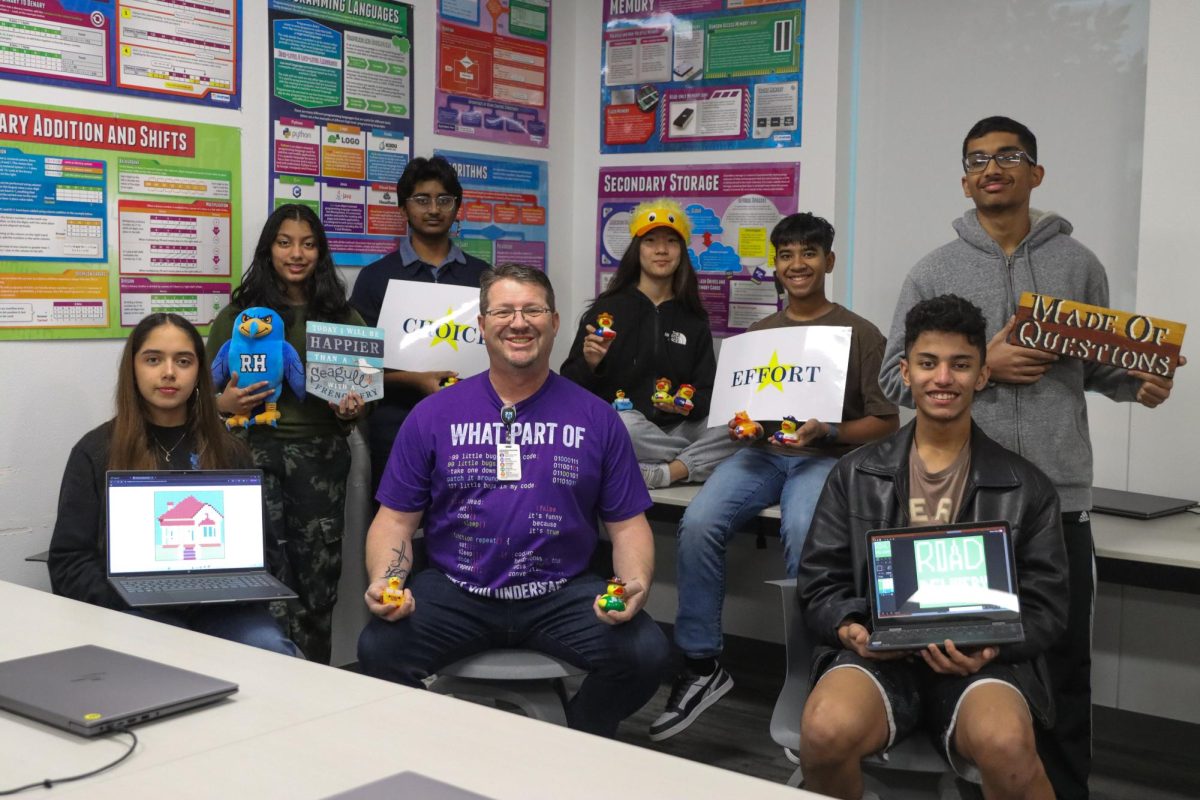
The world of coding has never been more vibrant: students in Mitch Schneider’s computer science class are transforming lines of code into colourful works of art through a pixel art project that combines creativity and technical skill. In this class, students learn valuable lessons about collaboration, thinking skills, and growth.
Using the programming language Python through the CodeHS application, freshmen are pixelating everything from smiley faces to hot air balloons, learning valuable lessons about planning and problem-solving along the way.
Freshman Tatvik Mukherjee used different tools to figure out how to create a hot air balloon design.
“We used a ton of different types of code, like functions, lists, and arrays,” Mukherjee said. “It was really complex, it was fun, and it taught me a lot about how planning is key because if you don’t plan it correctly, then you’re going to have more problems later on.
With outside experience from other classes, freshman Saanya Sandeep took a more unique approach with her project, using advanced techniques to make her design even better.
“I did a colour changing smiley face,” Sandeep said. “It was a simple design in terms of the actual image, but the unique part about it was that I had a function where every time you played it, it would appear as a different colour.
For Schneider, the pixel art project transcends mere programming instruction; it embodies his philosophy of nurturing critical thinking and personal growth, aiming to prepare students for challenges beyond the classroom.
“I’m not just trying to teach them how to code,” Schneider said. “I’m trying to teach them how to think. Rather than simply instructing students on programming commands, he focuses on sequencing, problem-solving, and understanding the why behind each line of code.
“Mr. Schneider tells us what we need to do; then he lets us free, allowing our imagination to take over.
Students describe their classroom as a nurturing space that encourages growth, citing examples like collaborative projects and personalized guidance that help them evolve as both programmers and individuals.
“He’s encouraged me to continue with a bit more complex structures and projects,” Sandeep said. “The functions that I didn’t know how to do, [Schneider] would sit and help me figure it out, even if he didn’t know how to do them. He also teaches us a lot about being better people.”